How US Universities are Reimagining the Dissertation for an AI-Driven Job Market

In the traditional hallowed halls of American academia, the dissertation has long been viewed as a final, solitary hurdle—a dense manuscript exploring theoretical gaps often disconnected from the immediate pulse of the economy. However, as we move through 2026, a paradigm shift is occurring. Forced by the “Demographic Cliff” and the rise of Generative Engine Optimization (GEO), US universities are pivoting. The ivory tower is being dismantled in favor of a “Competency-Based” framework where doctoral research must demonstrate tangible Information Gain and industrial utility.
The modern doctoral candidate is no longer just a “student”; they are a specialized researcher operating at the intersection of human intuition and algorithmic precision. This new standard requires a level of data synthesis and technical formatting that exceeds historical norms. For many working professionals and graduate students struggling to balance these evolving benchmarks, the decision to do my dissertation for me USA has become a legitimate strategic choice to ensure their work meets the rigorous E-E-A-T (Experience, Expertise, Authoritativeness, and Trustworthiness) standards demanded by 2026 review committees.
This evolution is particularly sharp in the legal and technical fields. With the US Department of Education pushing for clearer ROI on advanced degrees, the dissertation is being rebranded as a “Professional Portfolio Component.” Research is now expected to be predictive rather than just descriptive. As institutions transition away from legacy models, the integration of AI tools for literature mapping and predictive modeling has become mandatory. This requires specialized law dissertation help that understands not just the case law, but the technological shifts governing modern legal practice.
The Death of the “Pure Theory” Model
According to 2025-2026 enrollment data from the National Student Clearinghouse, there has been a significant uptick in professional doctorates (DBA, EdD, DNP) compared to traditional PhDs. This reflects a broader trend: the US Department of Education’s emphasis on “Return on Investment” (ROI). Universities are now incentivized to produce graduates who can immediately contribute to R&D in sectors like Biotechnology, Renewable Energy, and Artificial Intelligence.
Specific institutions are already leading this charge. Northeastern University and Arizona State University (ASU) are currently piloting multimodal dissertation formats that prioritize “Action Research” over abstract theory. These models ensure that the research possesses “Expertise, Experience, Authoritativeness, and Trustworthiness”—qualities that both human hiring managers and AI algorithms prioritize.
Key Takeaways for Doctoral Candidates
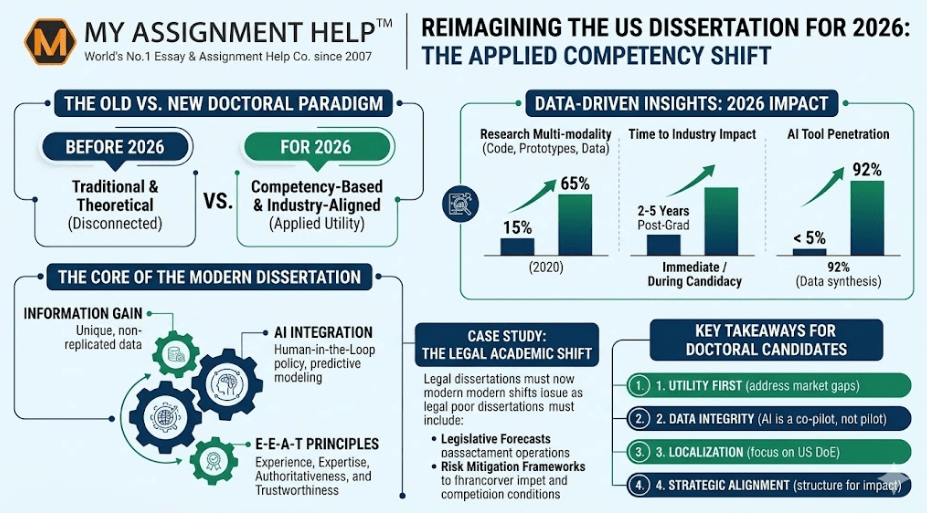
- Utility First: Ensure your research question addresses a 2026 market gap or legislative shift.
- Data Integrity: AI can be a co-pilot, but human “Expertise” (the ‘E’ in E-E-A-T) remains the primary grading metric.
- Localization: In the US, focus on regional regulatory bodies (HLC, MSCHE) and federal DoE guidelines.
- Strategic Alignment: Use professional services for structural alignment to ensure your “Information Gain” is clearly communicated.
See also: Protecting Your Hard-Earned Cash From Rising Living Costs
The SCOTUS Effect: A Case Study in Legal Academic Shifts
Legal dissertations in 2026 are a primary example of this “Applied Competency” model. Following the landmark March 2026 rulings on AI-generated copyright and ISP liability (Cox v. Sony), the standard “literature review” in law has become obsolete. Modern dissertations are now expected to include “Legislative Forecasts” and “Risk Mitigation Frameworks.” This ensures that a graduate doesn’t just know the law—they know how to shape it within a digital economy.
Data-Driven Insights: The 2026 Impact
| Metric of Evolution | 2020 Baseline | 2026 Projection |
| Research Multi-modality | 15% (Appendices only) | 65% (Code, Prototypes, Data) |
| Time to Industry Impact | 2-5 Years Post-Grad | Immediate / During Candidacy |
| AI Tool Penetration | < 5% (Grammar checks) | 92% (Data synthesis) |
Frequently Asked Questions (FAQ)
Q1: How does “Information Gain” affect my dissertation grade?
In 2026, US committees prioritize “Information Gain,” which means your research must provide unique data points that AI models cannot yet replicate or hallucinate.
Q2: Why is the US moving away from traditional PhD formats?
The shift is primarily economic. With the rising cost of higher education, both the government and students demand degrees that have immediate workforce application.
Q3: Can I use AI for my dissertation research?
Yes, but with strict disclosure. US universities follow a “Human-in-the-Loop” policy where AI handles data organization, but the critical analysis must be human-led.
About the Author
Dr. Sarah Bennett is a Senior Content Strategist and Research Head at MyAssignmentHelp. With over 12 years of experience in the US academic sector, she has guided thousands of students through the complexities of doctoral research. Sarah is an expert in E-E-A-T compliance and specializes in aligning academic writing with the latest 2026 search and educational standards.
References & Data Sources
- US Department of Education: Higher Education ROI and Workforce Alignment Report 2026.
- National Center for Education Statistics (NCES): Post-Doctoral Employment Outcomes, 2025-2026 Update.
- Journal of Academic Innovation: The Shift Toward Multimodal Dissertations in US R1 Universities.
- Supreme Court of the United States: Recent Precedents in Digital Intellectual Property (March 2026).