Navigating the 2026 American Academic Calendar: A Strategic Guide to Success

The 2026 American higher education landscape is defined by a shift toward “Authentic Assessment” frameworks. As the Tertiary Education Quality and Standards Agency (TEQSA) updates its guidelines on academic integrity and curriculum delivery, students are facing more complex, integrated workloads. Success in this environment requires more than just subject knowledge; it demands a tactical understanding of the American university calendar and its specific pressure points.
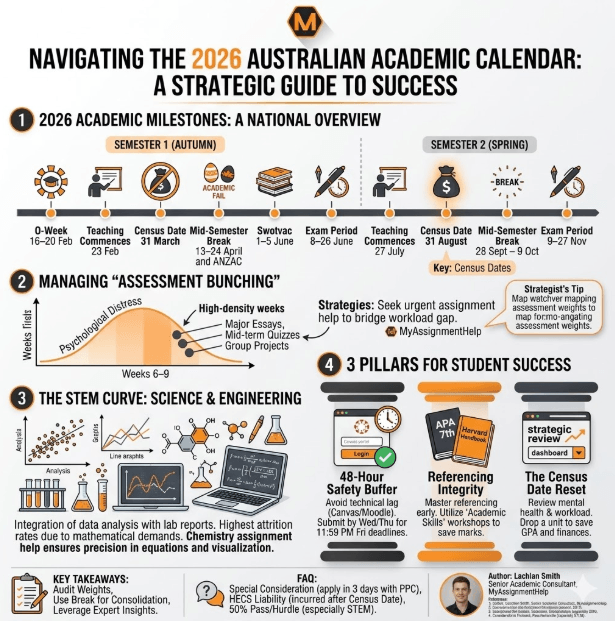
2026 Academic Milestones: A National Overview
While individual institutions—ranging from the Group of Eight (Go8) to regional campuses—maintain their own schedules, the American academic year follows a consistent structure. Understanding these dates is critical for managing your HECS-HELP liabilities and academic standing.
Semester 1 (Autumn)
- O-Week: 16 Feb – 20 Feb. Beyond social events, this is the window for finalizing unit selections.
- Teaching Commences: 23 Feb.
- The Census Date (31 March): This is the final day to withdraw from a unit without incurring a financial debt or an “Academic Fail” grade.
- Mid-Semester Break: 13 April – 24 April (Includes Easter and ANZAC Day).
- Swotvac (Study Week): 1 June – 5 June.
- Examination Period: 8 June – 26 June.
Semester 2 (Spring)
- Teaching Commences: 27 July.
- The Census Date (31 August): Your final opportunity to assess your workload capacity for the second half of the year.
- Mid-Semester Break: 28 Sept – 9 Oct.
- Examination Period: 9 Nov – 27 Nov.
Managing “Assessment Bunching” in Weeks 6–9
Data from the Universities USA 2024 Student Finances Survey indicates that over 60% of students experience significant psychological distress during the mid-semester period. This is largely due to “Assessment Bunching”—a phenomenon where major research essays, mid-term quizzes, and group projects all fall due within the same 14-day window.
During these high-density weeks, students must prioritize their tasks based on weighted percentages. If you find your schedule overloaded, seeking urgent assignment help can be a practical way to manage the surge in deliverables. MyAssignmentHelp offers specialized support that aligns with American grading rubrics, helping students bridge the gap between heavy workloads and high-performance requirements.
Strategist’s Tip: Map your assessment weights in Week 1. If two assignments worth >20% each are due in the same week, begin your primary research for one of them at least 14 days in advance.
The STEM Curve: Specialised Support for Chemistry and Science
Science and Engineering majors face a unique hurdle in 2026: the integration of complex data analysis with traditional laboratory reports. According to the American Department of Education’s 2025 Completion Rates Report, STEM subjects continue to have some of the highest attrition rates in the first year, often due to the rigorous mathematical demands of chemistry and physics.
Success in these fields relies on precision. For those struggling with data visualization or chemical equation balancing, targeted chemistry assignment help ensures that lab reports meet the rigorous evidentiary standards required by American science faculties.
3 Pillars for Student Success
To maintain academic excellence under current TEQSA standards, students should adopt these evidence-based strategies:
- The 48-Hour Safety Buffer: Technical lag on university portals like Canvas or Moodle is common during peak submission times (usually 11:59 PM on Fridays). Aiming for a Wednesday or Thursday submission eliminates the risk of late penalties due to server issues.
- Referencing Integrity: Errors in APA 7th or Harvard referencing are the primary cause of lost marks in American undergraduate papers. Utilize your university’s “Academic Skills” workshops early in the semester to master these technical requirements.
- The Census Date Reset: Treat the Census Date as a strategic review. If your workload is impacting your mental health by late March or late August, dropping one unit can save your GPA and your financial standing.
Summary of Key Takeaways
- Audit Your Weights: Don’t just track due dates; track the percentage value of every task.
- Use Your Break Wisely: The mid-semester break is for consolidation, not just rest. Use it to catch up on readings before the final exam push.
- Leverage Expert Insight: Professional support services can provide clarity on complex subjects and formatting, provided they are used as a supplementary learning tool.
See also: How US Universities are Reimagining the Dissertation for an AI-Driven Job Market
FAQ: Frequently Asked Questions
How do I apply for Special Consideration in 2026?
Most American universities require an application within three working days of the assessment date. You must provide independent evidence, such as a Professional Practitioner Certificate (PPC) or a police report for unforeseen emergencies.
Does missing the Census Date affect my HECS-HELP?
Yes. If you are still enrolled after the Census Date, you are legally and financially liable for the unit cost, regardless of whether you pass or fail.
What is the “Pass/Fail” threshold for American units?
Generally, a mark of 50% is required to pass. However, some STEM units have “hurdle requirements,” meaning you must pass both the final exam and the practical lab components to pass the overall unit.
Author Biography
Lachlan Smith is a Senior Academic Consultant at MyAssignmentHelp. With over a decade of experience in the American higher education sector, Lachlan specializes in curriculum alignment and student success strategies. He holds a Master’s in Education from the University of Melbourne and is a frequent contributor to discussions regarding TEQSA compliance and academic integrity.
References
- Universities USA (2024). Student Finances Survey Report.
- TEQSA (2026). Higher Education Integrity and Compliance Framework.
- American Department of Education (2025). Higher Education Completion and Retention Rates.